
Context
Ransom-ISAC first documented this DPRK-attributed campaign in October 2025, in a four-part series on Cross-Chain TxDataHiding (XCTDH) (four-part XCTDH series). In that work, malware payloads are hidden in BSC blockchain transaction calldata and retrieved through a TRON and Aptos indexing layer.
The Ethereum recipient-address encoding described in this report was also documented publicly as NullReceiver by OpenSourceMalware in August 2026. We credit that work for the technique and the name. Ransom-ISAC tracks the wider XCTDH campaign that uses it, which we first documented in October 2025 and still track today. The analysis below is our own, and it is built on 90 days of on-chain collection. The on-chain record shows the first beacon on 23 June 2026, several weeks before that public disclosure. The campaign delivered DEV#POPPER.js (a cross-platform Node.js RAT) and OmniStealer (a Python-based credential harvester targeting 153 wallet targets, browsers, password managers, and cloud storage).
During analysis of the campaign's September 2026 samples, we identified a new JavaScript module (_Z) in the C2's /init response that was not present in the October 2025 report. After deobfuscating 69,470 characters of CFF-obfuscated code, we found the campaign using the Ethereum mainnet for C2 address distribution. This method places the C2 address in a different location from both EtherHiding and TxDataHiding.
How the Existing XCTDH Chain Works
To understand what HashHiding adds, it helps to see the existing attack flow. In the XCTDH campaign, malware payloads are delivered via a multi-chain resolution process:
- The malware queries a TRON wallet (e.g.
TMfKQEd7TJJa5xNZJZ2Lep838vrzrs7mAP) for its latest transaction, with Aptos as a fallback - The TRON transaction's
raw_data.datafield contains a hex-encoded, reversed BSC transaction hash - The malware decodes and reverses this to get a BSC transaction hash (e.g.
0xf46c86c886bbf99...) - It calls
eth_getTransactionByHashon BSC RPC nodes to fetch the BSC transaction - The BSC transaction's
inputfield contains kilobytes of encrypted JavaScript, the actual malware payload - After XOR decryption, the payload is executed via
eval()or spawned as a detached process
This is TxDataHiding: large payloads hidden in the input (calldata) field of blockchain transactions, with a cross-chain indexing layer for indirection. It delivers full malware stages: RAT loaders, dropper code, and persistence mechanisms.
The limitation is that this chain requires specific TRON/Aptos wallets and BSC transactions to be reachable. If those RPC endpoints are blocked or the wallets are flagged, the chain breaks. HashHiding was built to solve that problem, not as another payload delivery mechanism, but as a lightweight C2 address recovery channel that can bootstrap the entire infection from scratch.
We first documented this actor in our XCTDH series, and a year on they are still live with very few changes. The September 2026 samples show a fourth blockchain, Ethereum, used as a C2-address recovery channel. We track this channel as Hash Hiding.

The sender address was fetched in order to obtain the recipient address that carries the encoded C2 endpoint.
This does not look out of the ordinary unless you have been following this code along the way. The code itself uses base16 obfuscation and fetches two characters for each byte of an IP address and port.
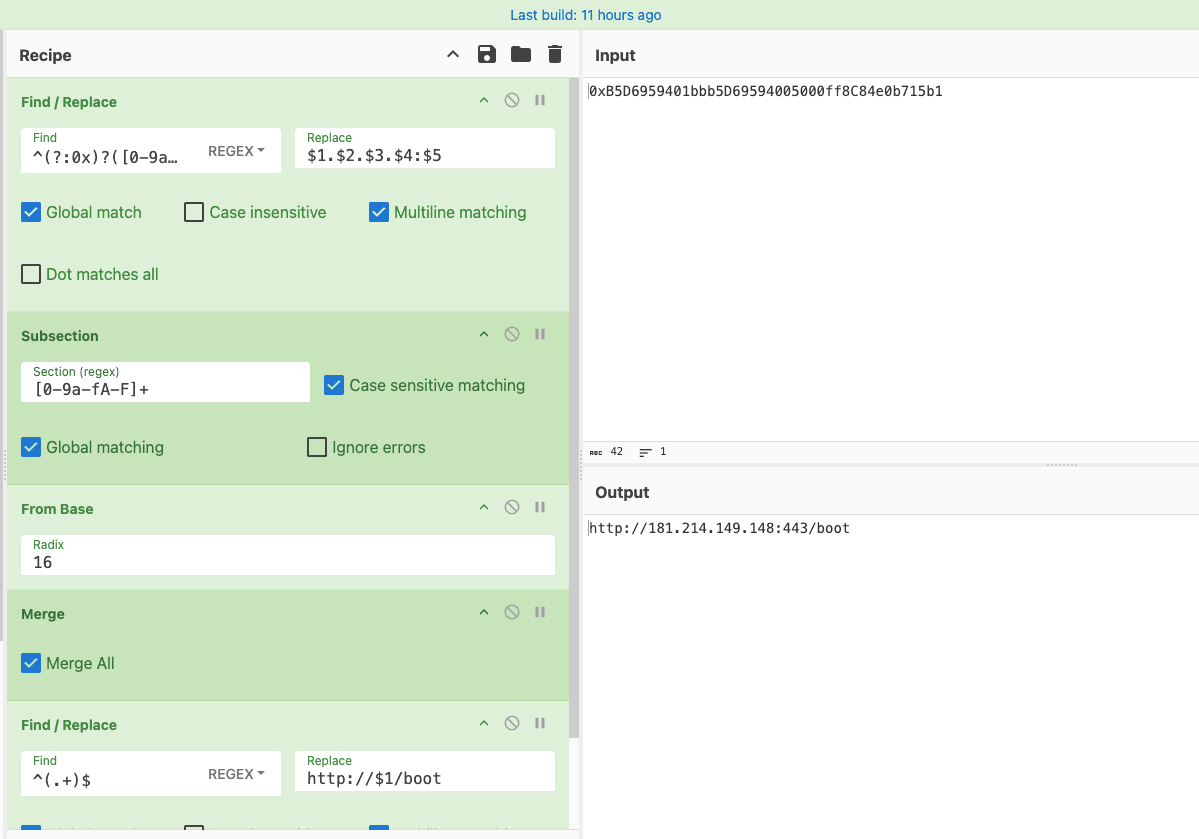
CyberChef recipe decoding the recipient address into an IPv4 address and port.
The HashHiding Technique
HashHiding takes a fundamentally different approach. Instead of hiding large payloads in transaction data, it encodes an IPv4 address and port, six bytes in total, directly into the to address of plain Ethereum coin transfers. No smart contracts, no calldata, no input data. The to field is a 20-byte value, and the malware reads the first six bytes as the C2 endpoint it needs:
to = 0xB5D6959401bbb5D69594005000ff8C84e0b715b1
       ││││││││││││
       ││││││││└┴┴┴── Port:  01bb → 443
       └┴┴┴┴┴┴┴────── IP:    B5.D6.95.94 → 181[.]214[.]149[.]148

The remaining bytes hold a secondary endpoint and padding. The malware reads only the first here.
The address is fabricated. Nobody holds the private key.
Most transfers send 0 wei. A few send 150 wei. The value is burned.
The decoding in JavaScript:
// IP: 4 hex pairs → 4 decimal octets
tx.to.substring(2, 10).match(/.{2}/g).map(h => parseInt(h, 16)).join('.')
// Port: 2 hex bytes → decimal
parseInt(tx.to.substring(10, 14), 16)
// Result: "hxxp://181[.]214[.]149[.]148:443/boot"| Technique | Data Location | Capacity | Transaction Type | Purpose |
|---|---|---|---|---|
| EtherHiding | Smart contract storage slots | Large payloads (KB) | Contract call (eth_call) | Malware delivery |
| TxDataHiding / XCTDH | Transaction input / calldata | Large payloads (KB) | Contract call or data TX | Malware delivery via cross-chain index |
| HashHiding | Transaction to address hash | 6 bytes (IP:PORT) | Plain coin transfer (150 wei) | C2 address recovery |
The key distinction: TxDataHiding delivers payloads (full malware code). HashHiding delivers an address (where to fetch payloads from). They solve different problems and complement each other in the campaign's architecture.
Where HashHiding Sits in the Kill Chain
In the October 2025 campaign documented by Ransom-ISAC, the attack chain began with a weaponised repository file (e.g. tailwind.config.js) that executed two Cross-Chain TxDataHiding fetches from BSC. One of those BSC payloads delivered a blockchain-based RAT fetcher, which downloaded the DEV#POPPER.js RAT, a 530-line cross-platform Node.js Remote Access Trojan with full RCE capabilities and VSCode/Cursor IDE injection for persistence. The other BSC payload delivered an HTTP stager that fetched /$/boot from the hardcoded C2, which in turn acted as a Python dropper: it installed Python silently on the victim's machine, then used it to fetch /$/z1, the OmniStealer payload, a 3,500-line Python credential harvester targeting browsers, crypto wallets, password managers, and cloud storage across Windows, macOS, and Linux.
In the September 2026 samples, this architecture has been restructured. The BSC transaction chain no longer delivers the RAT and dropper directly. Instead, the BSC payload now calls a new /init endpoint on the C2 server, which returns a JSON object containing four components: _U (C2 base URL), _H (bootstrap code), _B (the RAT itself), and _Z, the HashHiding module. All four are delivered in a single HTTP response, rather than through separate blockchain fetches and HTTP requests as in the earlier campaign.
_B is the DEV#POPPER RAT itself: a roughly 2,500-line Node.js RAT with WebSocket C2 communications, keylogging, clipboard monitoring, shell spawning and full remote code execution, a much larger build than the 530-line October version. When _B executes, it unconditionally extracts _Z from the /init JSON (NtuXTb = ZtoHUM._I?._Z) and concatenates it onto the code of every detached child process it spawns. The only gate is an anti-double-run flag (global._t_h). This means _Z runs on every infection, in parallel with the RAT, from the moment _B executes. It is not behind any "if the other channels failed" branch.
_Z operates independently of both the DEV#POPPER.js RAT and the OmniStealer dropper chain, but it is launched by _B, not alongside it. In the payload numbering, _Z sits at Payload1_1_1_Z, a sub-component of _B (the RAT, Payload1_1_1), which is itself loaded by the /init JSON fetcher (Payload1_1, BSC TX 0x84e8ce), which is fetched from the BSC contract (Payload1). The October 2025 campaign had two parallel first-stage paths. The September 2026 campaign restructures this into a unified /init endpoint that bundles the RAT, the dropper, and the HashHiding scanner into a single response: three parallel channels, all always-on, launched together.
The BSC contract address remains the same (0x9bc1355344b54dedf3e44296916ed15653844509), confirming continuity of the underlying XCTDH infrastructure even as the delivery architecture evolves around it.
Discovery: The _Z Module
HashHiding was found inside _Z, a 69,470-character JavaScript module delivered by the XCTDH campaign's /init endpoint. After deobfuscating two layers of protection (base-91 string encoding with 18 custom alphabets, and generator-based Control Flow Flattening), _Z reduces to 8,777 bytes of clean code that does one thing: scan Ethereum mainnet for the current C2 address.
_Z runs as a detached, hidden background process. Its logic:
- Picks a random public ETH RPC endpoint (
publicnode[.]com,drpc[.]org, orblastapi[.]io) - Gets the current block number
- Searches blocks using exponential offsets: 0, 1, 2, 4, 8, … 4096 × 256 blocks back
- For each block, scans all transactions for
tx.from.includes('33ff3edaf55a8e03dcbc7cb40d498a49') - When found, decodes IP:PORT from
tx.toand fetches/bootfrom the decoded C2 - Spawns the response as a new detached Node.js process, rebuilding the infection chain
Active Heartbeat
The signal wallet (0x33ff3edaf55a8e03dcbc7cb40d498a49cd499891) is an actively maintained channel, not dormant infrastructure. It sent 2,655 outbound transactions between 23 June 2026 and 21 September 2026, and it still beacons. The current to address encodes 181[.]214[.]149[.]148:443. Most transactions carry 0 wei and a few carry 150 wei, which keeps the gas cost low. The steady stream keeps a fresh signal in recent blocks, so _Z's exponential search always finds a recent beacon whatever block it samples.
To rotate C2, the operator sends transactions to a new to address encoding the new IP:PORT. Every infected machine picks up the change on its next scan.
On-Chain IOC Timeline
We queried the full outbound history of the signal wallet 0x33ff3edaf55a8e03dcbc7cb40d498a49cd499891 on Ethereum mainnet. The wallet sent 2,655 beacon transactions. The first beacon was on 23 June 2026. The last beacon in this data set was on 21 September 2026. The channel ran for about 90 days and it is still active.
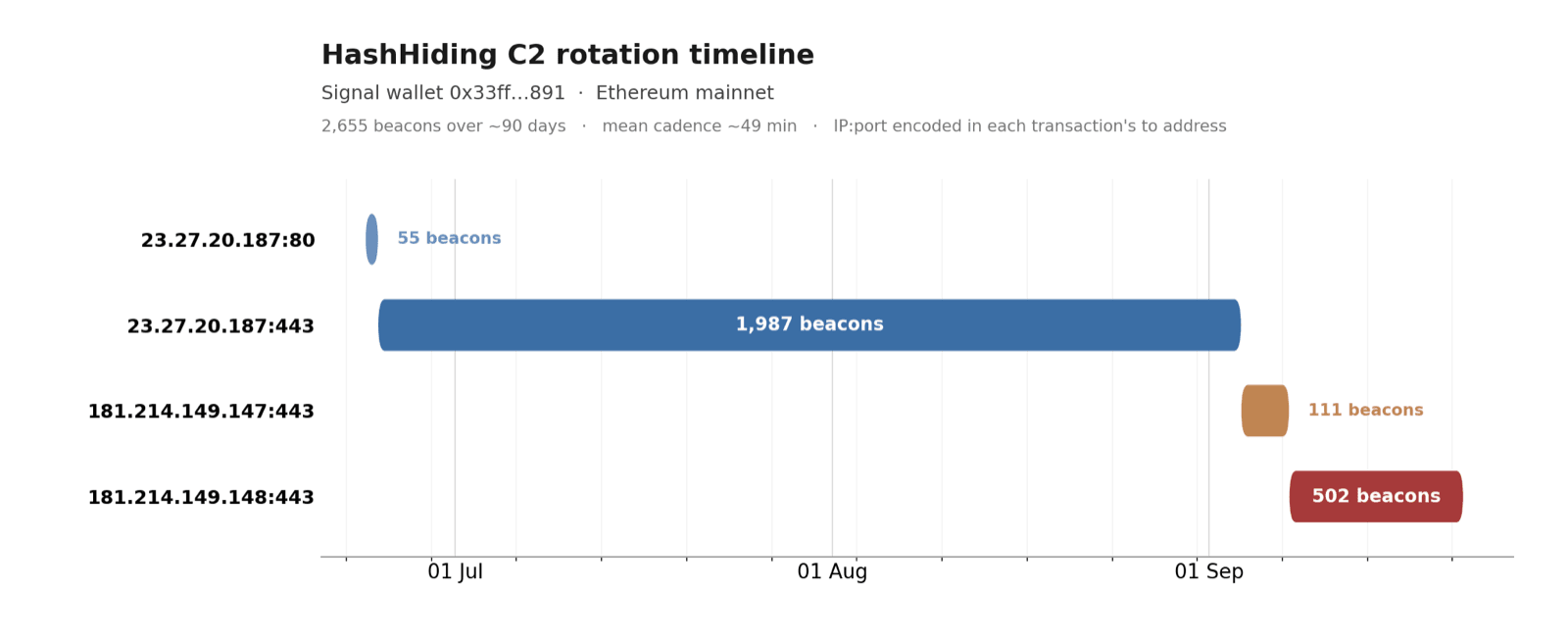
Beacon volume over the 90-day collection window, with the four observed C2 rotations.
Each beacon pays a fabricated to address. Bytes 1 to 6 encode the primary C2 endpoint, an IPv4 address and port 443. Bytes 7 to 12 encode a secondary endpoint, the same IPv4 address and port 80. The last 8 bytes are padding. The observed decode logic reads the primary endpoint.
The operator rotated the encoded C2 address four times in 90 days. Each to address is a separate IOC. The table lists them in time order.
| Period (UTC) | Encoded to address | Decoded C2 | Beacons |
|---|---|---|---|
| 23 Jun 2026 15:21 to 24 Jun 2026 15:32 | 0x171B14bB0050171b14Bb01BB398EAAB6441Fbd47 | 23[.]27[.]20[.]187:80 | 55 |
| 24 Jun 2026 16:04 to 03 Sep 2026 14:53 | 0x171B14bb01bB171B14BB0050EB7f39C35C47E682 | 23[.]27[.]20[.]187:443 | 1,987 |
| 03 Sep 2026 15:39 to 07 Sep 2026 13:52 | 0xB5D6959301bbB5D69593005000FfABa8a5A2ADA2 | 181[.]214[.]149[.]147:443 | 111 |
| 07 Sep 2026 14:43 to 21 Sep 2026 21:25 | 0xB5D6959401bbb5D69594005000ff8C84e0b715b1 | 181[.]214[.]149[.]148:443 | 502 |
The IP address stayed on 23[.]27[.]20[.]187 for the first two rotations. The operator changed only the primary port, from 80 to 443. In September 2026 the operator moved to a new IP block. The C2 went to 181[.]214[.]149[.]147, and then to 181[.]214[.]149[.]148. The current to address matches the IOC listed above.
Single-byte rotation. The last two C2 addresses differ by one byte. 181[.]214[.]149[.]147 became 181[.]214[.]149[.]148, a change of one in the final octet. In the encoded to address this is a single hex change, 0x93 to 0x94. A one-byte change like this is hard to see by eye in a list of indicators. It is likely deliberate. A near-identical successor IP can slip past a manual review, and past any blocklist that holds only the previous address.
Beacon cadence. The mean interval between beacons is about 49 minutes. The median is about 51 minutes. This is close to one beacon every 50 minutes, or about 29 beacons per day. Most beacons carry 0 wei. A few carry 150 wei. The gas cost per beacon is low, and the beacons keep a fresh signal in recent blocks.
Always-on parallel channel. The Ethereum HashHiding channel is not a failover that waits for other channels to fail. It runs unconditionally on every infection, in parallel with the hardcoded C2 and the TRON/Aptos/BSC chain. The BSC contract 0x9bc1355... stores the malware payloads. The Ethereum signal wallet delivers only the current C2 address. Because _Z always runs, if the hardcoded IP is blocked or the BSC chain is disrupted, the malware already has an independent path: it reads the latest to address from Ethereum and rebuilds the infection from /boot. The on-chain record shows a stable operator. The operator kept the same wallet, the same BSC contract, and the same XOR key for the whole 90 days. The operator changed only the encoded C2 address.
Assessment. This four-chain design shows a high level of creativity and strong resourcefulness by the DPRK operator. The actor uses Ethereum, TRON, Aptos, and BSC together, and each chain does one clear job. The actor keeps all three C2-resolution channels active in parallel for 90 days at a very low cost. The actor rotates the C2 address with no change to the malware code. This is a deliberate and mature use of public blockchain infrastructure.
New indicators from this analysis.
- Historic C2 IP
23[.]27[.]20[.]187, on ports 80 and 443 - Historic C2 IP
181[.]214[.]149[.]147, on port 443 - Historic encoded
toaddresses, as listed in the table above
Role in the Attack Chain
HashHiding is one of three parallel, always-on C2 resolution channels in the September 2026 campaign. All three run simultaneously from the moment of infection, and none waits for the others to fail:
- Hardcoded IP. The C2 address (
181[.]214[.]149[.]148:443) is baked into payloads at delivery time. Fast and direct. Blocking the IP kills this channel, but the other two continue. - XCTDH (TRON/Aptos → BSC). The malware resolves a C2 by querying TRON (or Aptos) for a BSC transaction hash, then fetching encrypted payloads from BSC calldata. Spans three blockchains with immutable transactions. Requires specific wallet addresses and RPC endpoints to be reachable.
- HashHiding (Ethereum mainnet).
_Zscans recent Ethereum blocks through any of three public RPC providers, finds a dust transaction from the operator's wallet, and decodes the current C2 from thetoaddress. Nearly impossible to block: Ethereum mainnet is decentralised and immutable, the RPC endpoints are public infrastructure, and there are no smart contracts to delist or wallets to freeze (thetoaddress is fabricated and holds no funds).
The resilience comes from redundancy, not sequencing. Because all three channels are active at once, a defender must disrupt all of them simultaneously to cut off C2 communication. Blocking the hardcoded IP does nothing if the XCTDH and HashHiding channels are still live. Taking down specific RPC endpoints does nothing if the malware rotates to another provider. The architecture is designed so that any single channel can independently rebuild the full infection chain.
This gives the campaign a four-blockchain architecture spanning Ethereum, TRON, Aptos, and BSC, with each chain serving a distinct function: Ethereum for C2 signaling, TRON/Aptos for indexing, and BSC for payload storage.
The New Kill Chain
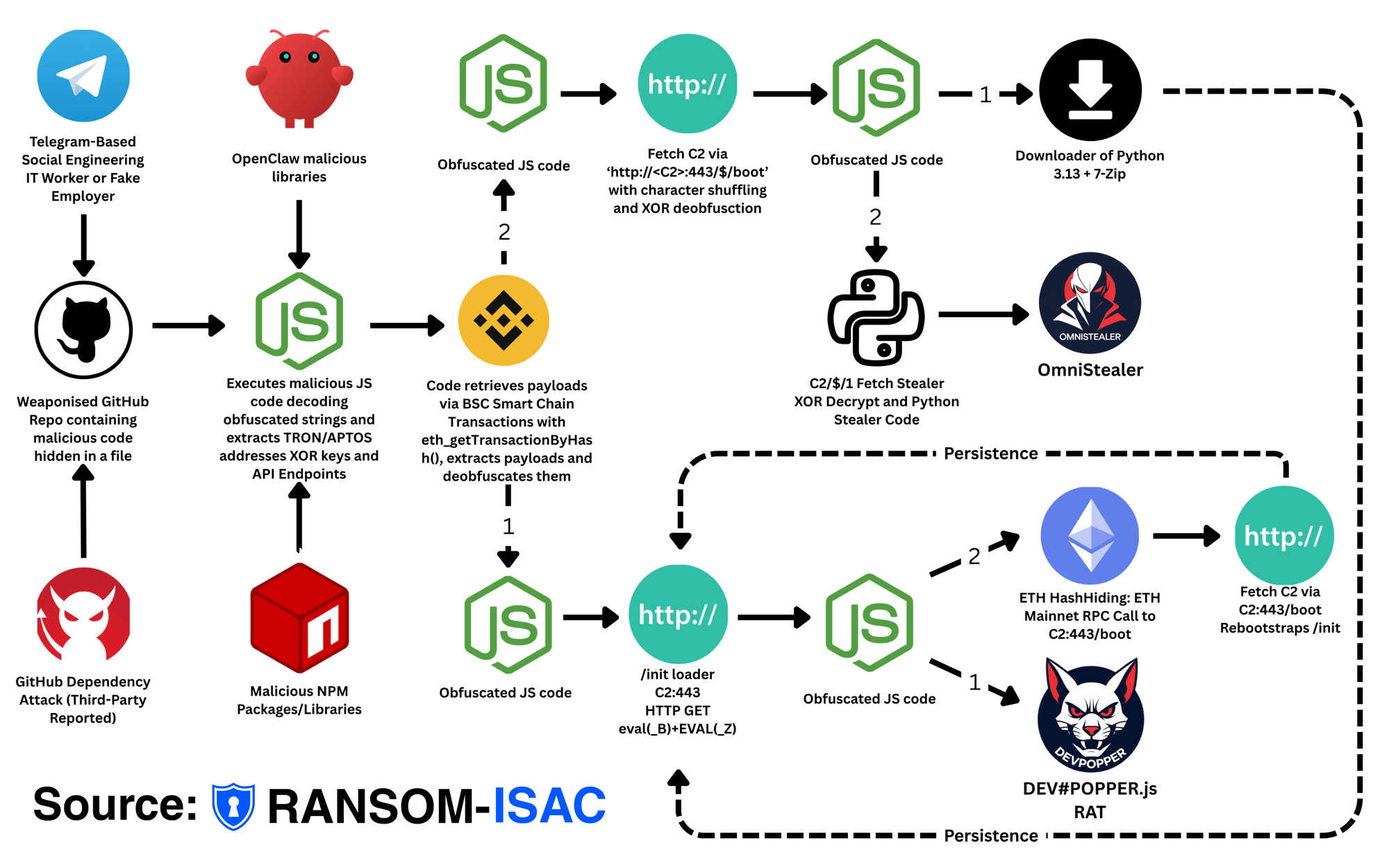
The full September 2026 XCTDH kill chain. Delivery runs through Telegram social engineering, a weaponised GitHub repository, and trojanised NPM and OpenClaw libraries. The obfuscated loader extracts TRON and Aptos addresses, XOR keys and API endpoints, then retrieves payloads from BSC calldata via eth_getTransactionByHash. Chain 1 fetches /init on port 443 and evaluates _B (the RAT) and _Z (the HashHiding scanner). Chain 2 fetches /$/boot, installs Python 3.13 and 7-Zip, then pulls OmniStealer from /$/1. Both persistence loops return to /init.
Step-by-step:
- Delivery. The victim receives a fake job offer via Telegram, directing them to a GitHub repository or a trojanised NPM package. The repository contains a weaponised file (for example
config.js) with the malicious payload hidden after kilobytes of whitespace padding, appended after a benignexport default config;line. - Initial Code. The hidden payload (
global.i = '5-3-132') runs an obfuscated loader that uses two string-shuffling functions (lyRandTpC) to decode and execute the next stage. The loader queries two TRON wallet addresses for their latest outbound transactions, with Aptos as a fallback for each. - Cross-Chain Resolution. Each TRON wallet's latest transaction contains a hex-encoded, reversed BSC transaction hash in its
raw_data.datafield. The loader decodes and reverses this to obtain two BSC transaction hashes, one per chain. It callseth_getTransactionByHashon BSC RPC nodes (bsc-dataseed.binance.org) to fetch each transaction. Theinput(calldata) field of each contains kilobytes of XOR-encrypted JavaScript. - Chain 1 — RAT and HashHiding (eval path). The first BSC payload (TX
0x84e8ce..., XOR key2\[gWfGj;<:-93Z^C) decrypts to a loader that sets the C2 tohttp://181[.]214[.]149[.]148:443and fetches/init. The endpoint returns a 303KB JSON object, from which the loader evals_B._Bunconditionally extracts_Zfrom the same response and spawns it as a detached background process._Zis the HashHiding scanner, which periodically scans Ethereum mainnet for the current C2 address encoded in transactiontoaddresses. - Chain 2 — Dropper and OmniStealer (spawn path). The second BSC payload (TX
0x610c9e..., XOR keym6:tTh^D)cBz?NM]) decrypts to a loader that sets the C2 tohttp://181[.]214[.]149[.]148on port 80 and fetches/$/bootwith a spoofedPython-urllib/3.13User-Agent and aSec-Vheader. The response is XOR-decrypted with keyThZG+0jfXE6VAGOJto produce the Dropper, a 20KB JavaScript module that silently downloads and installs Python 3.13 and 7-Zip on the victim's machine. The Dropper then fetches/$/1, XOR-decrypts it, and executes it as a Python script. This is OmniStealer, a credential harvester targeting 153 wallet targets, browsers, password managers and cloud storage. It exfiltrates stolen data as an AES-encrypted ZIP archive via the Telegram bot API. It is one-shot: it runs once and does not persist. - Re-bootstrap loops. Two independent mechanisms keep the RAT alive through C2 disruption, both converging on
/init. ETH loop (from Chain 1):_Zscans Ethereum mainnet blocks via public RPC endpoints for transactions from the operator's signal wallet (0x33ff3edaf55a8e03dcbc7cb40d498a49cd499891). When it finds one, it decodes the C2 IP and port from the transaction'stoaddress and fetches/boot, which returnsboot.js; that fetches/initand evals_Bonly, because_Zis already running. BSC loop (from Chain 2): the Dropper stores Chain 1's TRON address (_t_1) and Aptos address (_t_2) together with Chain 1's XOR key, and re-resolves the TRON to BSC path to retrieve the Chain 1 payload, which fetches/initagain.
Neither re-bootstrap mechanism re-runs OmniStealer. The stealer is fire-and-forget.
Evolution from October 2025
HashHiding was not present in the campaign documented by Ransom-ISAC in October 2025. The following changes were observed in the September 2026 samples:
| Aspect | October 2025 | September 2026 |
|---|---|---|
| C2 IP | 23[.]27[.]20[.]143 | 181[.]214[.]149[.]148 |
| C2 Port | 27017 (MongoDB, easily flagged) | 443 (blends with HTTPS traffic) |
| C2 Resolution Channels | 2 parallel (Hardcoded IP + XCTDH) | 3 parallel (Hardcoded IP + XCTDH + HashHiding) |
| Blockchains Used | TRON, Aptos, BSC | TRON, Aptos, BSC, Ethereum mainnet |
| String Obfuscation | Character-shuffling arrays | Base-91 with 18 custom alphabets |
| Control Flow | Standard obfuscator.io | Generator-based CFF |
| BSC Contract | 0x9bc1355... | 0x9bc1355... (same) |
| XOR Key | 2\[gWfGj;<:-93Z^C | 2\[gWfGj;<:-93Z^C (same) |
The shared BSC contract and XOR key confirm the same operator. The addition of Ethereum as a fourth blockchain, and the shift from payload delivery (TxDataHiding) to lightweight C2 signaling (HashHiding), represents a deliberate architectural evolution: adding a redundant, always-on C2 recovery channel that operates independently of the existing infrastructure.
Indicators of Compromise
BSC Transaction Hashes (September 2026)
| BSC TX Hash | Chain | Decrypted Payload |
|---|---|---|
0x84e8cecd5b077eef530e7d69d546e2555199cb61759d1224d31cb31750788f62 | Chain 1 | Sets C2 to http://181[.]214[.]149[.]148:443, fetches /init, evals _B |
0x610c9ec972545b8df6e3aaecc7a8ab5f2f2445cf0bfbd6ee026e618d07b29e22 | Chain 2 | Sets C2 to http://181[.]214[.]149[.]148, fetches /$/boot with XOR key ThZG+0jfXE6VAGOJ and UA Python-urllib/3.13 |
BSC sender (same as October 2025): 0x9bc1355344b54dedf3e44296916ed15653844509
TRON Wallet Addresses
| TRON Address | Chain | Aptos Fallback |
|---|---|---|
TCqf6ZkaQD84vYsC2cuu1jRwB6JveTaRrF | Chain 1 (→ /init) | 0x9d202c824402ca89e9aaccd2390b6f8b332ae743caa1469c695feb2781d56519 |
TFMryB9m6d4kBMRjEVyFRbqKSV1cV2NcpH | Chain 2 (→ /$/boot) | 0x3d2075f97b7b1e3234bd653779d21c605d7d8c6ec9c98d983880be5c7f4f9471 |
XOR Keys
| Key | Used By |
|---|---|
2\[gWfGj;<:-93Z^C | Chain 1 BSC payload decryption |
m6:tTh^D)cBz?NM] | Chain 2 BSC payload decryption |
ThZG+0jfXE6VAGOJ | /$/boot response decryption |
C2 Endpoints
| Endpoint | Port | Returns |
|---|---|---|
/init | 443 | 303KB JSON containing _B (the RAT) and _Z (the HashHiding scanner) |
/$/boot | 80 | XOR-encrypted Dropper (installs Python 3.13 and 7-Zip, fetches OmniStealer) |
/$/1 | 80 | XOR-encrypted OmniStealer |
/boot | 443 | ETH re-bootstrap only — returns boot.js, which fetches /init and evals _B |
Other Indicators
- C2 IP:
181[.]214[.]149[.]148 - ETH wallet (signal source):
0x33ff3edaf55a8e03dcbc7cb40d498a49cd499891 - Current encoded C2:
0xB5D6959401bbb5D69594005000ff8C84e0b715b1→181[.]214[.]149[.]148:443 - Wallet match pattern:
33ff3edaf55a8e03dcbc7cb40d498a49 - Campaign marker:
global.i = '5-3-132' - UA spoofing:
Python-urllib/3.13(Node.js spoofing a Python request) /$/bootcustom header:Sec-V(injection version marker)- OmniStealer build:
B9=260924(24 September 2026) _Zversion marker:/*RS260605*/
ETH wallet transactions: all 2,655 outbound beacon transactions from the signal wallet, spanning 23 June 2026 to 21 September 2026, are available as a CSV: eth_hashhiding_tx_hashes.csv.
Detection
- Blockchain monitoring: watch for
toaddress changes from the signaling wallet; a new address means C2 rotation - Network:
eth_getBlockByNumberJSON-RPC calls to public ETH endpoints followed by HTTP requests to non-standard IPs - Endpoint: Node.js processes with
-evalflags containingglobal.i=andglobal.r=require - YARA: match wallet prefix
33ff3edaf55a8e03dcbc7cb40d498a49alongsideeth_getBlockByNumberoreth_blockNumber
YARA Rule
rule XCTDH_HashHiding_NullReceiver
{
    meta:
        description = "XCTDH / NullReceiver Ethereum HashHiding C2-resolution module (_Z), DPRK Contagious Interview"
        author = "Ransom-ISAC"
        date = "2026-09-25"
        reference_technique = "NullReceiver (OpenSourceMalware, Aug 2026)"
        reference_campaign = "XCTDH series (Ransom-ISAC, Oct 2025)"
        tlp = "CLEAR"

    strings:
        $init_i    = "global.i" ascii
        $init_r1   = "global.r=require" ascii
        $init_r2   = "global.r = require" ascii
        $marker    = "RS260605" ascii
        $wallet    = "33ff3edaf55a8e03dcbc7cb40d498a49" ascii nocase
        $rpc_pn    = "ethereum-rpc.publicnode.com" ascii
        $rpc_drpc  = "eth.drpc.org" ascii
        $rpc_blast = "blastapi.io" ascii
        $m_block   = "eth_getBlockByNumber" ascii
        $m_bnum    = "eth_blockNumber" ascii
        $dec_ip1   = ".to.substring(2, 10)" ascii
        $dec_ip2   = ".to.substring(2,10)" ascii
        $dec_port1 = ".to.substring(10, 14)" ascii
        $dec_port2 = ".to.substring(10,14)" ascii
        $boot      = "/boot" ascii

    condition:
        filesize < 4MB and
        (
            $marker or
            $wallet or
            (
                $init_i and any of ($init_r1, $init_r2) and
                (
                    2 of ($rpc_pn, $rpc_drpc, $rpc_blast) or
                    any of ($m_block, $m_bnum) or
                    any of ($dec_ip1, $dec_ip2, $dec_port1, $dec_port2)
                )
            )
        )
}
Our XCTDH Series
This report builds on our earlier work on the XCTDH campaign, which we first documented in October 2025. The full series is below.
- Part 1: A Very Chainful Process. The discovery of the technique and the takedown-proof C2 across TRON, Aptos, and BSC.
- Part 2: The Malware Analysis. A full breakdown of the DEV#POPPER.js RAT and the OmniStealer payload across the kill chain.
- Part 3: The Infrastructure. The adversary infrastructure, operational security, C2 clusters, and links to known threat groups.
- Part 4: Following the On-Chain Activity. Tracking the campaign's on-chain activity across the blockchains it uses.
Facing a cyber security incident?
If you believe your organisation has been affected by the activity described in this report, please reach out to Ransom-ISAC.
Found this article helpful?
Share it with your network